Olympic National Forest occupies the collar of land surrounding Olympic National Park on Washington's Olympic Peninsula, a roughly rectangular landmass jutting into the Pacific between Puget Sound and the open ocean. The forest's 628,000 acres wrap around the park's wilderness core like a frame, providing access corridors to the interior and protecting the transition zone between the managed working landscape and the fully protected park. Where the park's interior is roadless and managed as wilderness, the national forest contains campgrounds, recreation trails, and the forest roads that connect the ring of small communities around the peninsula.
The defining characteristic of the western side of this forest is moisture. The Olympic Mountains act as a barrier to Pacific storms, wringing out rainfall before it can cross to the east. The result is the Hoh Rain Forest and the Quinault and Queets valleys, where annual precipitation exceeds 140 inches and the forest grows to a scale that most Americans have never seen outside of photographs. Sitka spruce reach 300 feet. Western red cedar logs 10 feet in diameter are common. Elk trails wind through undergrowth so thick that the forest floor feels like a separate world from the canopy above.
The contrast with the eastern peninsula is striking. Less than 30 miles from the soaking Hoh valley, the town of Sequim sits in a rain shadow and averages 16 inches of precipitation a year, surrounded by lavender farms and dry conifer forest. Olympic National Forest spans this entire spectrum, from temperate rainforest to dryland Douglas fir. The variety within a single day's drive is extraordinary.
Why Olympic Stands Out
The Temperate Rainforest
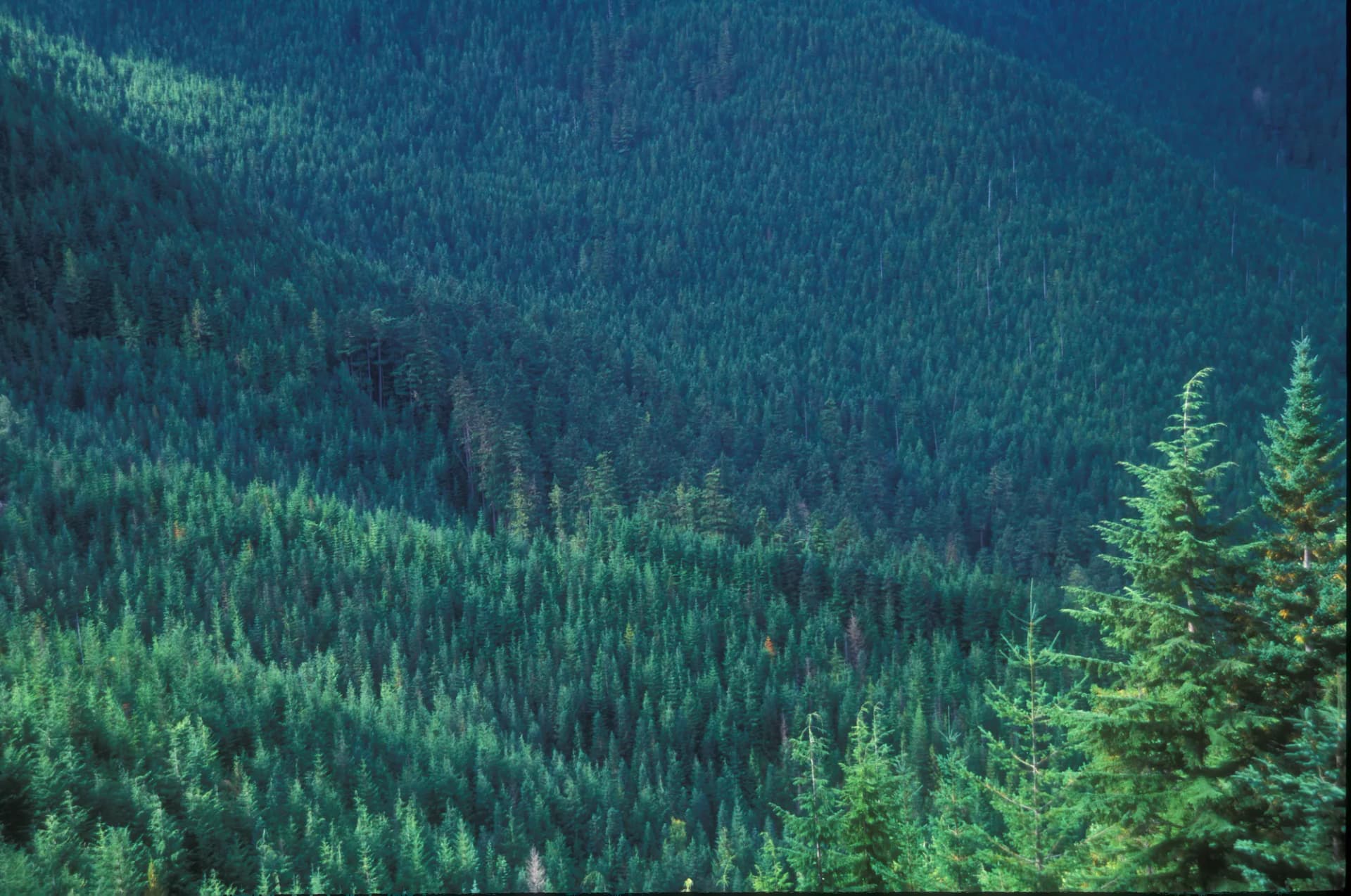
The western valleys of Olympic National Forest and Park constitute one of the largest temperate rainforests in North America. The Hoh, Queets, and Quinault valleys each offer distinct character, but all share the same defining features: moss-draped bigleaf maple, massive Sitka spruce and western red cedar, and a stillness broken only by the sound of rain and river. The Hoh River Trail in particular offers a flat, accessible entry into this landscape without requiring significant fitness.
Old-Growth Corridor Access
Much of the western United States' old-growth forest was logged during the 20th century. The Olympic Peninsula retained a significant portion of its old-growth because its terrain was difficult and remote. Olympic National Forest retains old-growth stands in its river valley corridors that are among the most intact lowland old-growth forests on the Pacific Coast.
The Hurricane Ridge Zone
The northern portion of the forest climbs into the Olympic Mountains toward Hurricane Ridge, where subalpine meadows and views across the Strait of Juan de Fuca to Victoria, BC are the reward for a 5,200-foot drive or hike. This area sits primarily within Olympic National Park but the approach and many surrounding trails fall within the National Forest jurisdiction.
Best Trails in Olympic National Forest
Hurricane Hill is a 3.2-mile out-and-back from Hurricane Ridge that climbs to an open summit with views spanning the Strait of Juan de Fuca, the San Juan Islands, and the Olympic Mountains interior. See the Hurricane Hill trail guide.
Sol Duc Falls is among the most accessible waterfall hikes in the Pacific Northwest. The 1.8-mile round trip follows a well-maintained path to a thundering four-channel falls on the Sol Duc River. Full details at the Sol Duc Falls guide.
Mount Storm King is the trail for those who want a demanding climb in the Lake Crescent area. The 4.4-mile route gains 1,700 feet to a viewpoint above the lake. Details at the Mount Storm King guide.
Seven Lakes Basin Loop is the premier backpacking route accessible from the Sol Duc area, a 19.2-mile circuit through subalpine lakes, alpine meadows, and old-growth forest. See the Seven Lakes Basin guide for the full route breakdown.
Permits and Passes
A Northwest Forest Pass is required at most Olympic National Forest trailheads (as of 2026). Where trails begin in Olympic National Park, the park entry fee applies instead. The America the Beautiful Interagency Annual Pass covers both. Veterans and active military may be eligible for a free pass; see veteran benefits for national forests.
Backcountry camping in the wilderness areas of the forest requires a self-issue permit (free at trailheads as of 2026). Olympic National Park backcountry permits have their own system; see the national forest camping permit guide for the general process and the Olympic NPS website for park-specific permits.
Camping
Klahowya Campground on Highway 101 is one of the most popular developed campgrounds in the forest, with 55 sites in old-growth forest along the Sol Duc River. Reservations through Recreation.gov are common in summer. Falls Creek Campground near Quinault offers riverside camping in a rain forest setting without reservations.
Dispersed camping is permitted in most national forest areas outside designated campgrounds. Follow Leave No Trace principles including the seven LNT practices and camp 200 feet from water and trails.
When to Visit
June through October is the reliable season for most trails. High routes like Hurricane Hill and Seven Lakes Basin may hold snow into July. The lowland Hoh River Trail and other valley walks are accessible year-round, though winter brings heavy rain and occasional flooding.
Summer (July through August) brings the most stable weather but also the most visitors. September is an excellent month: crowds thin, rain patterns often ease, and mushrooms begin appearing on the forest floor. October is wet but beautiful, with the bigleaf maples turning gold in the rainforest valleys.
Getting There
From Seattle, reach the Olympic Peninsula via the Hood Canal Bridge (Highway 104 to US-101) or via the Washington State Ferry from Seattle to Bremerton or Kingston. Total drive time to Port Angeles from Seattle is approximately 2 to 2.5 hours with the ferry, or 3 hours driving around through Tacoma and Shelton.
From Port Angeles, Highway 101 west and Highway 112 west provide access to most northern and western trailheads. The Hoh Rain Forest is approximately 80 miles southwest of Port Angeles via Highway 101.
Practical Tips
- The western side of the peninsula is genuinely wet. Rain gear is appropriate any time of year.
- Olympic National Forest has no cell service through most of its area. Download offline maps before leaving town.
- Driving times on the peninsula are longer than the map suggests due to winding two-lane roads.
- The national forest vs. national park guide explains the different rules and fees that apply depending on which side of the park-forest boundary you are hiking.
- Review current conditions before heading out, particularly for river trail flooding after heavy rain.
Planning Your Trip
The Olympic National Forest Supervisor's Office is in Olympia. Ranger districts with local trail information include the Hood Canal Ranger District in Hoodsport and the Pacific Ranger District in Forks. The Forks office is the best resource for western peninsula and Hoh-area trails.